Life Lessons Kids Can Learn from Bubbles Away
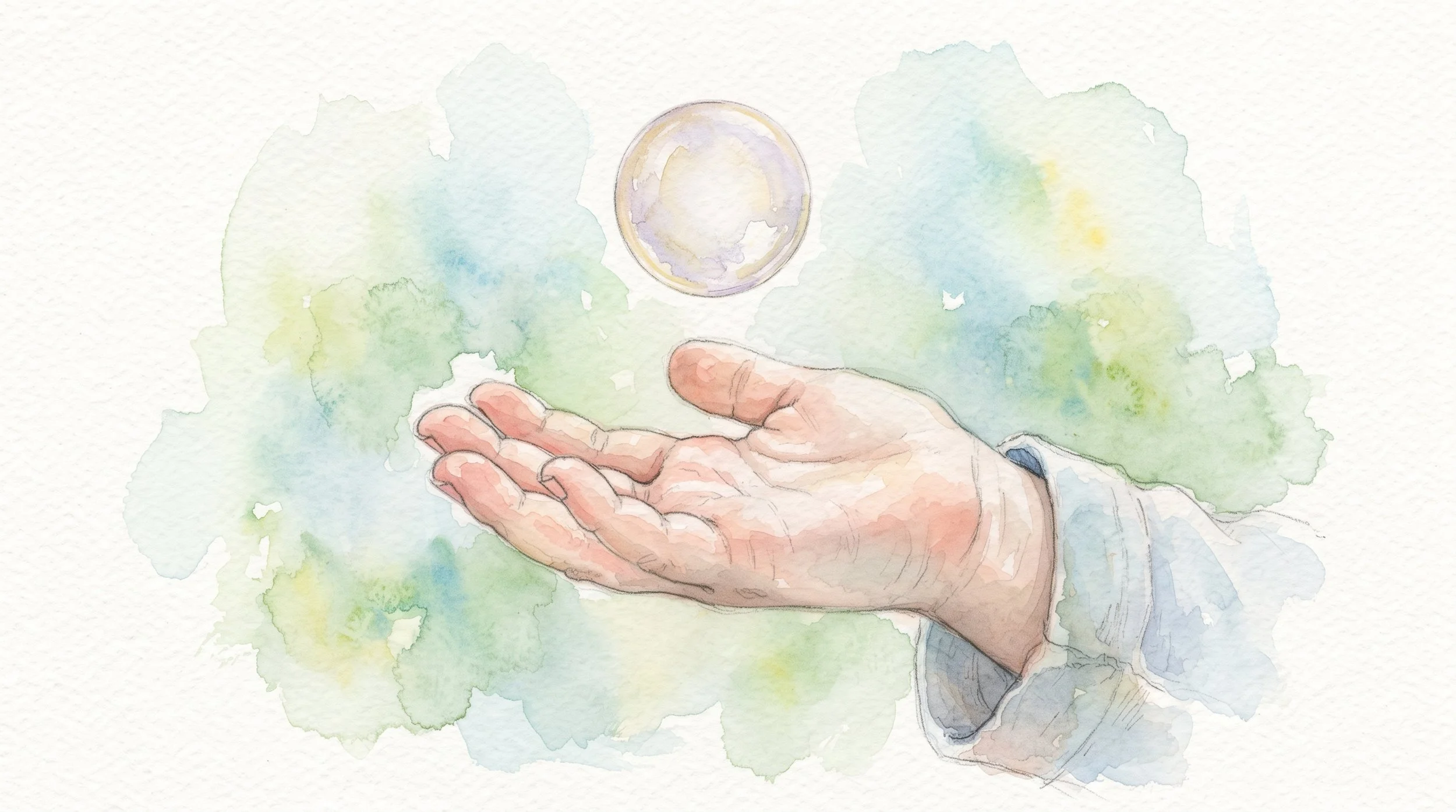
The wind that day was fierce and it did not treat the bubbles gently. It took them off across the grass, around the pond, out into the fields, and the big dog ran as fast as he could after every one of them until they blew clear into the woods and were gone. He did not get a single one.
Weebit released them into the sky and said it. Then said it again.
“Bye-bye, bubbles! Goodbye!”
Not once. Again and again.
I have thought about that moment more than any other in the whole book, and I believe it teaches without direct instruction. Everything before it is a good morning. That is the part where something happens to a person.
Because here is what I have learned watching children, and watching myself: the life lessons for kids that stick are almost never the ones we announce. They are the ones a child stumbles into while she thinks she is just playing. I wrote Bubbles Away about the morning my granddaughter learned to blow bubbles for the first time, and what I did not understand until I was writing it down is that learning to blow one was the easy half. Learning to watch it go was the whole education.
THE BOOK IS NAMED AFTER THE LEAVING
Look at the title again. It is not Bubbles. It is Bubbles Away.
I did not notice what I had done until the manuscript was finished. And then I looked at the line that comes back over and over through the story, the one the whole book turns on, and it says the same thing. The day the bubbles blew away. Not the day we blew bubbles. Not the day we played. The day they blew away.
Weebit is not celebrated for making something. She is celebrated for a morning that is defined, in its own title, by the thing she could not keep.
I am not sure I would have chosen that on purpose. It chose itself, because that is what happened, and it turns out that is what happens with almost everything worth having. You do not get to hold the good morning. You get to have been in it.
SHE SAID IT AGAIN AND AGAIN
That line is the one I want you to look at hardest, and it is not the word goodbye. It is again and again.
She did not say goodbye once, the way a grown-up does, briskly, already thinking about lunch. She stood there and said it to one bubble. And then she said it to the next one. And then the next.
That is a child practicing.
I do not think she knew that. I am quite sure she thought she was talking to bubbles! But watch what her small self was doing. She was taking something that was leaving and, instead of chasing it like the dog did, instead of crying about it, instead of demanding another one right this second, she was turning toward it and marking it. Naming it. Letting it be over, out loud, on purpose, in her own voice.
We spend a good part of adulthood trying to learn that and mostly failing. She was doing it at the pond in a homemade hat, on a Tuesday, for fun.
WHAT A CLOSED FIST TEACHES
Try it the other way and see what you get.
A child who grabs at a bubble gets soap on her fingers and nothing else. That is the whole result. Every single time. The bubble is not built to survive being held and no amount of wanting changes what it is made of. And a child who has been taught, gently or otherwise, that the correct response to a good thing is to seize it will spend her whole childhood with wet hands and an empty fist, wondering why the world keeps breaking.
The child who waves gets to watch the bubble cross the pond.
She gets the flight. She gets the color as it reflects turning in the sun. She gets the dog making an absolute fool of himself in the new spring grass. She gets the whole rest of the journey, all of it, right up until the woods take it. She gets more of the bubble by letting go of it than she ever could have gotten by closing her hand.
That is not a consolation prize for losing. That is the actual prize, and the grabbing child never once sees it.
YOU CAN ONLY OPEN YOUR HAND IF SOMEONE ELSE IS HOLDING THINGS
A child can not be talked into open hands. I have tried. You cannot argue a two-year-old out of a fist.
What you can do is show her a world that is worth trusting.
That morning, the wind that carried the bubbles away was the same wind that made them worth blowing. It was the same sky, the same field, the same God who had already put purple crocuses up through grass that had been dead and brown all winter with nobody watching and nobody asking. My hope for every child who reads this book is exactly what it is for my grandchildren, which is that they learn to trust God with their lives and walk with Him each day, knowing He holds the future.
A child can open her hand because somebody else has hold of the thing. That is the whole foundation under the waving. Take it out and the waving is just loss with a brave face on it.
But leave it in, and watch what she does. She lets go of the bubble and it costs her nothing, because she was never the one keeping it up there in the first place.
ONE LAST THOUGHT
We spend an enormous amount of energy teaching children to hold on. Hold my hand, hold still, hold onto your cup, hold onto that thought.
Almost nobody teaches them the other half, and the other half is where the life is. My granddaughter learned it in about four seconds on a blustery morning without one word of instruction from me.
So blow the bubbles. Let the wind take them into the woods. And when your child stands there in the cold saying goodbye to each one, again and again, do not hurry her along and do not fill her hands with something else. She is not sad. She is not missing out.
She is learning the thing. Let her finish.
FAQ:
What age is this lesson actually appropriate for? Younger than you would guess. A toddler who waves at a departing car is already doing it. You are not explaining a concept to her, you are giving her practice at something she can already feel. The words come later. The waving comes first.
My child cries when the bubbles pop. Am I doing this wrong? Not remotely. Crying is an honest response to a thing ending and it is a feeling being felt. Sit with her in it. Do not rush to make another one. The grief and the wave are the same skill at different ages.
Do I need to explain the meaning of the story to my child? Please do not. The moment you announce a lesson, it stops being a discovery and becomes a chore, and children can smell the difference instantly. Read the story. Blow the bubbles. Let it work on her the way it worked on me, which is to say slowly.
Isn’t this just teaching kids to give up on things? It is the opposite, and the distinction matters. Giving up is letting go of what you could have kept. This is letting go of what was never keepable. A child who knows which is which will fight harder for the things that are actually worth the fight.
What if I struggle with this more than my child does? Then you are in excellent company and you should say so out loud. There is no rule that the grown-up has to have finished learning first. Some of the best moments I have had as a MawMaw are the ones where I am learning right along side or a little one got there ahead of me. Experiencing the struggle with them reminds me, I am to have faith as a little one.